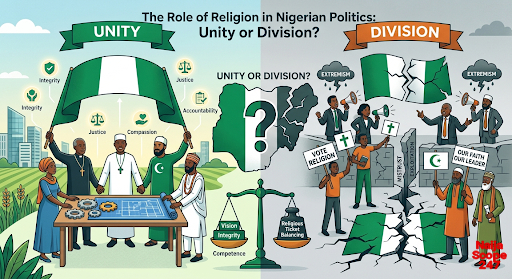

Nigeria is widely known as one of the most religious countries in the world. With Christianity and Islam as the two dominant faiths—alongside traditional beliefs—religion plays a central role in the daily lives of millions of Nigerians. It influences values, decisions, and social interactions. However, when religion intersects with politics, the outcome is often complex, raising a critical question: does religion unite Nigerians politically, or does it deepen divisions?
Religion as a Unifying Force
At its best, religion promotes values that are essential for good governance—integrity, justice, compassion, and accountability. Religious institutions in Nigeria have historically contributed to national development through education, healthcare, and humanitarian services.
In politics, religious leaders often encourage peaceful coexistence, voter participation, and moral conduct among political actors. During elections, many churches and mosques preach messages of peace, urging their members to avoid violence and uphold democratic values. This moral guidance can help stabilize the political environment, especially during tense periods.
Additionally, interfaith collaborations—where Christian and Muslim leaders come together—have, at times, helped to calm tensions and promote national unity. These efforts show that religion can indeed serve as a bridge rather than a barrier.
The Reality of Religious Influence in Political Decisions
Despite its unifying potential, religion often plays a decisive role in political choices. Many voters consider the religious identity of candidates before casting their ballots. Political parties are also mindful of religious balance when selecting candidates, especially for top offices.
For instance, the concept of “religious ticket balancing” (pairing a Christian with a Muslim candidate) has become a common political strategy aimed at appealing to a broader electorate. While this may promote inclusiveness on the surface, it also highlights how deeply religion is embedded in Nigeria’s political calculations.
Religion as a Source of Division
Unfortunately, religion has also been a source of political tension and division in Nigeria. Differences in religious beliefs sometimes fuel mistrust, suspicion, and conflict among citizens.
Political actors occasionally exploit these differences for personal gain, using religious sentiments to mobilize support or discredit opponents. Campaign messages may subtly—or openly—appeal to religious loyalties, creating an “us versus them” mentality.
In some cases, this has led to violence, particularly in regions where religious identities overlap with ethnic and political interests. Such conflicts not only threaten national unity but also undermine the democratic process.
The Danger of Extremism and Intolerance
Another concern is the rise of religious extremism and intolerance. When individuals or groups believe their religion should dominate political space, it can lead to exclusion and marginalization of others.
This mindset is dangerous in a diverse country like Nigeria, where peaceful coexistence depends on mutual respect and inclusion. Politics driven by religious supremacy risks alienating large segments of the population and weakening the nation’s democratic foundations.
The Way Forward: Separating Faith from Politics?
While it may be unrealistic to completely separate religion from politics in Nigeria, there is a growing need to redefine the relationship between the two. Religion should inspire ethical leadership, not determine political eligibility or loyalty.
Voters must begin to prioritize competence, vision, and integrity over religious affiliation when choosing leaders. At the same time, political leaders should avoid exploiting religious sentiments and instead focus on policies that benefit all citizens, regardless of faith.
Religious leaders also have a responsibility to promote unity, tolerance, and critical thinking among their followers. By discouraging blind allegiance and encouraging informed decision-making, they can help create a more balanced political landscape.
Conclusion
Religion remains a powerful force in Nigerian society, and its influence on politics cannot be ignored. It has the potential to unite citizens under shared moral values, but it can also divide when misused or manipulated.
The choice between unity and division ultimately lies in how religion is applied within the political sphere. If guided by principles of peace, fairness, and inclusivity, religion can strengthen Nigeria’s democracy. But if driven by bias and intolerance, it risks pulling the nation further apart.
For Nigeria to move forward, both citizens and leaders must ensure that religion becomes a tool for unity—not a weapon of division.